

Most people would probably be shocked to know how much technology lives inside the truck that picks up their trash. Check out all the ways we use it to make your service safer and more efficient.
Truck Tablets
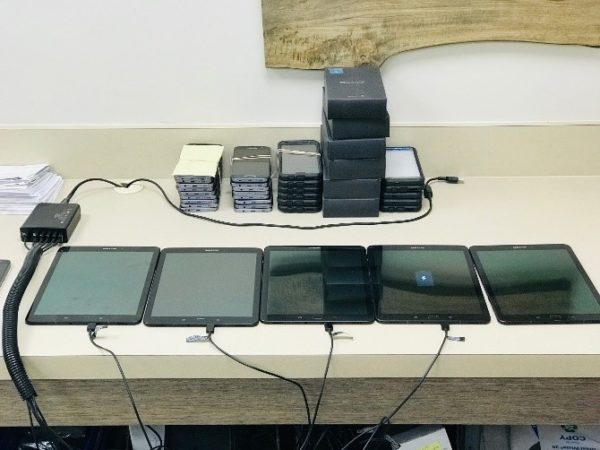
All Granger garbage trucks have electronic routing that allows near real-time communication of the status of a route, including how many stops have been picked up, who has not put their trash out, work orders for delivery and pickup of large temporary containers and the ability to capture images of trash volume at any individual customer’s container.
Truck Smart Phones
Along with tablets, every Granger garbage truck has a smart phone. These are used primarily to communicate with supervisors, should the occasion arise, but also are used to track driver hours and jobs through smart apps. (Phones are used either when a vehicle is safely parked or by a non-driving associate riding in the truck. Associates are instructed that phones should not be used while driving, either to make or answer calls, text or use other applications.)
Safety Cameras
Most Granger equipment, both on and off road, used in the landfill or out on the road, has a multi-camera DVR device recording all information in a 360-degree bubble around the vehicle. That’s a whopping 650 cameras that record all day. These cameras help drivers see materials being loaded into their vehicles and minimize blind spots around the vehicle. They allow heavy equipment operators to monitor landfill traffic near them for safer operation. Supervisors can also use footage for coaching and training purposes, creating high safety standards for the fleet.
Truck Engine Diagnostic Software
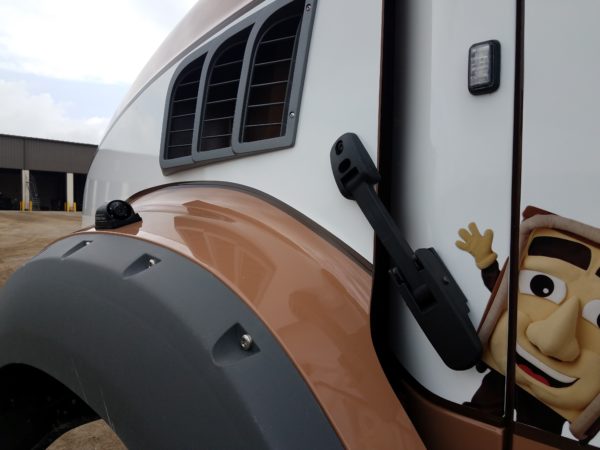
Just as the equipment inside the cab has gone tech heavy, so have the engines and transmissions of our vehicles. Every division has up to three diagnostic laptops that help troubleshoot issues with the vehicles. These devices use software from vendors like Mack, Cummins, Caterpillar and Detroit Diesel. Without these devices, diagnosing problems such as exhaust after treatment issues would be much more time-consuming and expensive.
GPS
Global positioning systems help our landfill crew compact all that collected trash in the most efficient way possible, which is necessary, particularly when you’re using more than 400 gallons of fuel a day to run that landfill equipment. This equipment allows equipment operators to see areas that need further compaction and those that have been compacted enough. Additionally, this data can be viewed by office staff using a web-based system. They can then use this information to do long-term planning and complete required reporting for the landfill.

GIS
Geographic information systems are the science of “where.” The amount of data our garbage trucks produce is astonishing. We generate more than one million waypoints a week with the GPS systems in the trucks. This kind of data can be converted and placed as points on a map to show supervisors roads travelled, speeds recorded and potential areas for marketing. GIS allows us to visually represent the areas we are in and help our customer service teams be as accurate and efficient as possible, along with providing management of visual data to help with business-critical decisions.
